 how-to
Furnace Repair Passaic County NJ: 2026 Homeowner Guide
Table of Contents
- Furnace Repair in Passaic County NJ: When to Call for Help
- Signs of a Failing Furnace Every Homeowner Should Know
- Furnace Troubleshooting Tips You Can Try Safely
- Emergency Heating Repair: What to Expect When Your Heat Fails
- Repair or Replace? Making the Call on an Aging Furnace
- Seasonal Maintenance Schedules and Energy Rebates That Cut Costs
- Why Licensed and Insured HVAC Technicians Matter in Passaic County
- Conclusion
- Frequently Asked Questions
Last Updated: September 15, 2026
Furnace Repair in Passaic County NJ: When to Call for Help
Furnace repair in Passaic County NJ starts with knowing the difference between a system that needs a minor adjustment and one heading toward failure. At Tornado HVAC, we run service calls across Bergen, Essex, Morris, Passaic, and Union counties all winter, and homeowners who call early spend less and stay warmer than those who wait for a breakdown.
A furnace burns fuel or runs electric resistance coils to warm air, then pushes it through your ductwork. When it stops doing that reliably, you have three options: diagnose it yourself, call a technician, or wait and hope. Two are usually mistakes.
Below: the warning signs worth acting on, the troubleshooting steps you can safely handle, when an emergency call is justified, and how to decide between repairing and replacing an aging unit.
Signs of a Failing Furnace Every Homeowner Should Know
The clearest signs of a failing furnace are unusual noises, odd smells, uneven heating, and short cycling. One alone may be minor; two or more together usually points to a component wearing out.
Noises, Smells, and Temperature Drops That Signal Trouble
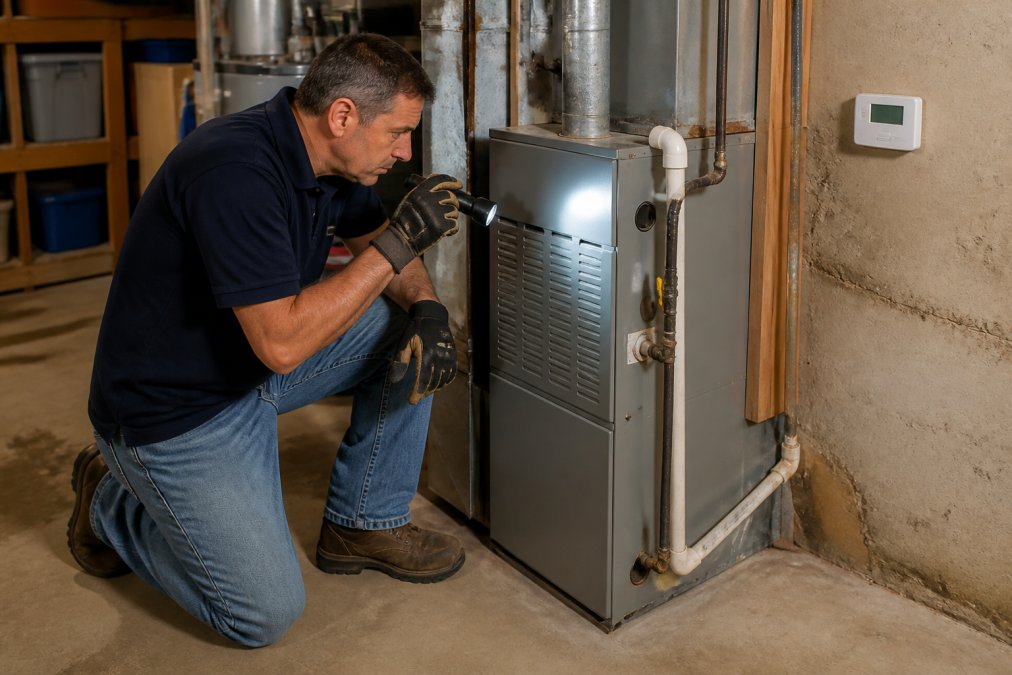
A furnace that bangs, rumbles, or squeals is telling you something. A metallic bang on startup often points to delayed ignition (energy.gov). A high-pitched squeal usually means a blower motor bearing is failing. Persistent rumbling can indicate a dirty burner or a heat exchanger problem, the heat exchanger separates combustion gases from the air you breathe.
Smells matter too. A faint dusty smell on the first cold day is normal, since dust is burning off the heat exchanger. Rotten eggs mean you should leave the house and call your gas utility immediately. A burning or metallic smell that persists past the first cycle warrants a service call.
Temperature drops are the quietest warning sign. If your thermostat is set to 70 but the far bedrooms sit at 62, the furnace may be losing capacity or the ductwork may be leaking. A technician can measure temperature rise at the supply and return to tell you which.
- Banging or booming on startup - possible delayed ignition
- Squealing or grinding - blower motor or belt wear
- Rotten egg smell - gas leak, leave and call the utility
- Persistent burning smell - possible electrical or heat exchanger issue
- Rooms that never reach setpoint - capacity loss or duct leakage
- Short cycling - furnace turns on and off every few minutes
Furnace Troubleshooting Tips You Can Try Safely
Safe furnace troubleshooting covers four things: the thermostat, the filter, the power supply, and the air path. Anything involving gas lines, the burner assembly, or the heat exchanger belongs to a licensed technician.
Start with the thermostat. Confirm it is set to Heat, not Auto or Cool, and that the setpoint is at least three degrees above room temperature. Replace the batteries if it runs on them. A surprising number of "dead furnace" calls end here.
Next, check the filter. A clogged filter restricts airflow, causing the furnace to overheat and shut down on its safety limit (energy.gov). If it is gray and matted, replace it, the most common cause of a furnace that runs but does not heat well.
Then verify power. Check the breaker panel for a tripped breaker labeled for the furnace or air handler. If it trips again immediately after reset, stop and call a technician, a breaker that keeps tripping is protecting you from something.
Finally, confirm the air path. Make sure supply registers and return grilles are not blocked by furniture, rugs, or closed doors.
A DIY Safety Checklist Before You Touch Anything
Run through this before you open a panel or touch a wire:
- If you smell gas, leave the house and call your gas utility from outside
- Shut off power at the breaker before removing any panel
- Never bypass a safety switch or limit control
- Do not attempt to clean or adjust the burner assembly
- Do not open the sealed combustion chamber
- If you see soot, corrosion, or a cracked surface near the heat exchanger, stop and call a professional
- Keep children and pets away from the work area
- If you are unsure at any step, stop and schedule service
Emergency Heating Repair: What to Expect When Your Heat Fails
Emergency heating repair is warranted when you have no heat and outdoor temperatures are dropping, when you smell gas, when you see sparks or smoke, or when the furnace repeatedly trips a breaker. Stop troubleshooting and call for service.
When you call, expect a dispatcher to ask what the furnace is doing, whether you smell gas, and whether anyone in the home has health concerns. The technician will diagnose the unit, explain what failed, and give you a clear written recommendation before any work begins.
While waiting on a technician in cold weather, close off unused rooms, run space heaters in the room you occupy, and let a faucet drip to reduce the risk of frozen pipes. Do not use a gas oven or charcoal grill to heat your home.
Repair or Replace? Making the Call on an Aging Furnace
The repair-or-replace decision comes down to four factors: the age of the unit, what actually failed, how often you have called for service in the past two years, and whether the failure is a safety issue. Cost matters, but it is the last filter, not the first.
Start with what failed, because not all parts age the same way. A failed ignitor, flame sensor, inducer motor, or blower motor is a discrete component with a known service life, and replacing one on a furnace with years left is usually straightforward. A failed heat exchanger is different: on most residential furnaces it is not a practical repair, because the exchanger is the core of the unit and replacing it approaches the cost and labor of a new furnace.
Age sets the ceiling. Furnaces under 10 years old with a single failed part are almost always worth repairing; units in the 10-to-15-year range depend on the specific part and how the rest of the system tests; units past 15 years rarely make sense to repair when a major component fails. A 16-year-old furnace has a blower, control board, and inducer all near the end of their service life, so you may be paying for the next failure before you finish paying for this one.
Service history is the tiebreaker. Two or more repair calls in the past two years on a unit over 10 years old is a pattern, not bad luck.
| Situation | Likely Recommendation | Why |
|---|---|---|
| Under 10 years, one failed part | Repair | Component life remains, cost is contained |
| 10-15 years, minor repair | Repair, then evaluate | Watch for repeat failures |
| 10-15 years, major component | Weigh both options | Compare against long-term reliability |
| Over 15 years, any major repair | Replace | Remaining service life is short |
| Any age, cracked heat exchanger | Replace | Safety issue, not a repair candidate |
| Any age, repeated CO readings | Replace | Combustion problem that cannot be corrected |
Seasonal Maintenance Schedules and Energy Rebates That Cut Costs
A calendar-based schedule for this region looks like this:
Where the Money Actually Comes From
Why Licensed and Insured HVAC Technicians Matter in Passaic County
Conclusion
Frequently Asked Questions
What are the signs that my furnace needs professional repair?
Watch for unusual banging or rattling noises, a yellow instead of blue pilot light, frequent cycling, cold air from vents, or a furnace that runs constantly without warming the house. Soot streaks, a burning smell, or rising energy bills also point to trouble. If your furnace shows any of these signs, schedule a professional inspection before the problem worsens.
What should I check before calling for emergency furnace service?
Check your thermostat batteries and settings, confirm the furnace switch is on, and replace a clogged air filter. Verify that your circuit breaker hasn't tripped and that the gas valve is open. If the furnace still won't start after these steps, call for emergency heating repair. Never attempt to open the unit or handle gas lines yourself.
How often should I schedule furnace maintenance to avoid breakdowns?
Schedule a professional tune-up once a year, ideally in early fall before heating season begins. Annual maintenance catches worn parts, dirty burners, and airflow issues before they cause a mid-winter failure. Homeowners with older systems or heavy usage may benefit from a seasonal check in both fall and spring.
Is it better to repair or replace a furnace that is over 20 years old?
A furnace over 20 years old often costs more to repair than it's worth, especially if it needs major components like a heat exchanger or blower motor. Frequent breakdowns, rising energy bills, and parts availability all factor into the decision. A technician can assess efficiency and safety to help you decide whether repair or replacement makes more sense.