 how-to
How to Verify HVAC Technician Credentials: 2026 Guide
Table of Contents
- Why Verifying HVAC Technician Credentials Matters
- Step 1: Find Your State's License Lookup Tool
- Step 2: Read the License Record and Confirm Active Status
- Step 3: Check EPA 608 Certification Lookup for Refrigerant Work
- Step 4: How to Check HVAC Business Insurance and Bonding
- Step 5: Questions to Ask an HVAC Technician Before Hiring
- Red Flags of Unlicensed Contractors and How to Report Them
- Frequently Asked Questions
Last Updated: September 11, 2026
Why Verifying HVAC Technician Credentials Matters
Verifying HVAC technician credentials is the single most effective way to protect your home, your wallet, and your family from a bad repair. It means confirming, through official state and federal records, that the person working on your heating and cooling system holds a valid license, carries the right insurance, and has the certifications required for the specific work being done.
Most homeowners skip this step. They assume the company that answered the phone already did it. That assumption is where trouble starts.
At Tornado HVAC, we work in Bergen, Essex, Morris, Passaic, and Union counties, and we hear stories from homeowners who hired someone who seemed legitimate, paid for a repair, and then discovered the work was never permitted, never inspected, and never covered by insurance. By then, the technician is unreachable.
What Can Go Wrong With an Unverified Technician
An unlicensed technician can install a furnace incorrectly, creating a carbon monoxide hazard. They can wire a heat pump to the wrong breaker, voiding your manufacturer warranty. They can pull a permit under someone else's license number, leaving you legally responsible for code violations you never knew existed.
The financial exposure is real. If an uninsured technician is injured in your home, your homeowner's policy may be asked to cover the medical costs. If the work fails inspection, you pay twice: once for the bad installation, once for the correction.
Verification takes about ten minutes. That is the entire argument for doing it.
Step 1: Find Your State's License Lookup Tool
Every state regulates HVAC contracting through a licensing board, and nearly all of them publish a free public lookup tool. In New Jersey, the New Jersey Division of Consumer Affairs license verification portal lets you search by name, license number, or business entity.
Start with the company name, not the individual technician's name. The business entity holds the master license, and individual technicians work under it. If the company name returns no results, that is your first red flag.
Search variations matter. Try the full legal name, the shortened trade name, and the owner's name. Businesses often register under an LLC that differs from what appears on the truck.
How to Search the Official Registry
- Go to your state's licensing board website and locate the license search page.
- Choose the search type: individual, business, or license number.
- Enter the company name exactly as it appears on your estimate or invoice.
- If no match appears, try the owner's name or the license number printed on the van.
- Open the matching record and read every field, not just the status.
A search that returns nothing is not proof of a scam. It may mean the company operates under a different registered name. It does mean you should not sign anything until you resolve the discrepancy.
Step 2: Read the License Record and Confirm Active Status
An active license is not the same as a license in good standing. This distinction trips up more homeowners than any other part of the process, and it is the reason you should never stop reading at the status field.
A record marked "Active" means the license has not expired or been suspended. It does not tell you whether complaints are pending, whether the required insurance has lapsed, or whether the holder has a disciplinary history. You have to read the whole record.
The Fields That Actually Matter
License lookup records are built for regulators, not homeowners, so the important information is often buried. Work through these fields in order:
- License number and type. Confirm the number matches what the technician or office gave you, and that the license type covers the trade you need, heating, cooling, refrigeration, or plumbing are often licensed separately.
- Status and status date. "Active," "Expired," "Suspended," "Revoked," and "Voluntarily Surrendered" mean very different things. A surrendered license is not a clean record; it usually means the holder gave up the license while facing discipline.
- Expiration date. It must fall after your scheduled work date, not just after today. If it expires next week, the technician may not be legally able to finish the job.
- Business entity and trade name. The name on the license should match your contract and your invoice. A mismatch is not automatically fraud, but it is a question you should ask before signing.
- Qualifying individual or master licensee. Many states license a business through one named master licensee. If that person has left the company, the business may be operating without a valid qualifier, a detail worth confirming on the record.
- Insurance and bond on file. Some boards list whether the required coverage is current. If the record shows a lapsed policy, treat it as a stop sign.
Reading Complaint and Disciplinary History
Most state boards publish complaint disclosures and disciplinary actions directly on the license record. Look for suspended periods, fines, consent orders, citations, and pending cases.
One resolved complaint from years ago is not disqualifying. A pattern of unresolved complaints about the same issue, failed inspections, abandoned jobs, refund disputes, is a clear signal to walk away. Pay attention to the dates: a cluster of complaints in the last year tells you more than a single old one.
If the record links to a disciplinary document, open it. The order usually names the specific violation, which is far more useful than a one-line summary.
When the Record Does Not Match What You Were Told
If the name, number, or license type does not line up, do not sign. Ask the company to explain the discrepancy in writing. Legitimate businesses can usually resolve it in a sentence, a trade name versus a legal name, a recent renewal, a new qualifier. If the explanation is vague or the office gets defensive, that is your answer.
A search that returns nothing is not proof of a scam. It may mean the company operates under a different registered name, or that the work is regulated at the local level rather than the state level. It does mean you should not sign anything until you resolve the discrepancy.
Step 3: Check EPA 608 Certification Lookup for Refrigerant Work
EPA Section 608 certification is a federal requirement for any technician who handles refrigerants. It is separate from a state contractor license, and a state license does not substitute for it.
If your repair involves adding refrigerant, diagnosing a leak, or replacing a compressor, the technician must hold a valid Section 608 certificate. Ask for the certification number and the type: Type I covers small appliances, Type II covers high-pressure systems, and Type III covers low-pressure equipment. Most residential air conditioning work requires Type II.
The EPA Section 608 certification requirements and technician standards explain which certification type applies to which equipment. There is no single national public lookup database for individual technicians, so the practical step is to ask the company for the certificate number and confirm it matches the technician who arrives.
Step 4: How to Check HVAC Business Insurance and Bonding
Most guides stop at the license. That is a mistake, because a valid license says nothing about whether the company can pay for damage it causes in your home. Insurance and bonding are the second half of verification, and almost no homeowner-focused guide walks through them properly.
The Three Coverages That Protect You
General liability insurance covers damage to your property, a scratched hardwood floor, a broken window, a refrigerant line punctured through a finished ceiling. Ask what the per-occurrence limit is. A policy with a very low limit may not cover a serious mistake.
Workers' compensation insurance covers injuries to the technician while on your property. This is the coverage homeowners underestimate most. If an uninsured worker is hurt in your home, the claim can land on your homeowner's policy, and your premiums can follow.
A surety bond is a separate instrument, not insurance. It protects you if the company fails to complete the work, abandons the job, or violates state contracting rules. Bond amounts are often modest, so treat the bond as a backstop, not a guarantee.
How to Verify a Policy, Not Just Read a Certificate
A certificate of insurance is a summary document, and summaries can be altered, outdated, or issued for a policy that has since been canceled. The certificate alone proves nothing. Verify it directly:
- Ask for a certificate of insurance that names the company, the carrier, the policy numbers, and the effective dates.
- Call the carrier's claims or agent line, the number on the carrier's own website, not the number printed on the certificate.
- Give the policy number and ask two questions: is the policy active today, and does it cover the date of your scheduled work?
- Ask whether the policy includes workers' compensation or whether that is a separate policy.
- Request written confirmation by email and keep it with your contract.
That last step matters. If a dispute arises later, you have documented proof of what the company represented at the time you hired them.
Bonding and Registration Checks
If your state requires HVAC contractors to carry a surety bond, the bond is usually filed with the licensing board or a state registration office. You can often confirm the bond on the same license record you already pulled in Step 2. If the bond is not listed, ask the company for the bond number and the surety company, then call the surety directly to confirm it is current.
What to Do If Coverage Falls Short
If the company cannot produce a certificate, if the carrier says the policy is inactive, or if the coverage does not extend to your scheduled work date, do not proceed. This is not a paperwork formality, it is the difference between a covered repair and an out-of-pocket loss. A company that is fully insured will produce this information quickly. One that stalls, deflects, or promises to "send it later" is telling you something.
Step 5: Questions to Ask an HVAC Technician Before Hiring
The right questions to ask an HVAC technician before hiring reveal more than any license record. A licensed technician with nothing to hide will answer all of them without hesitation.
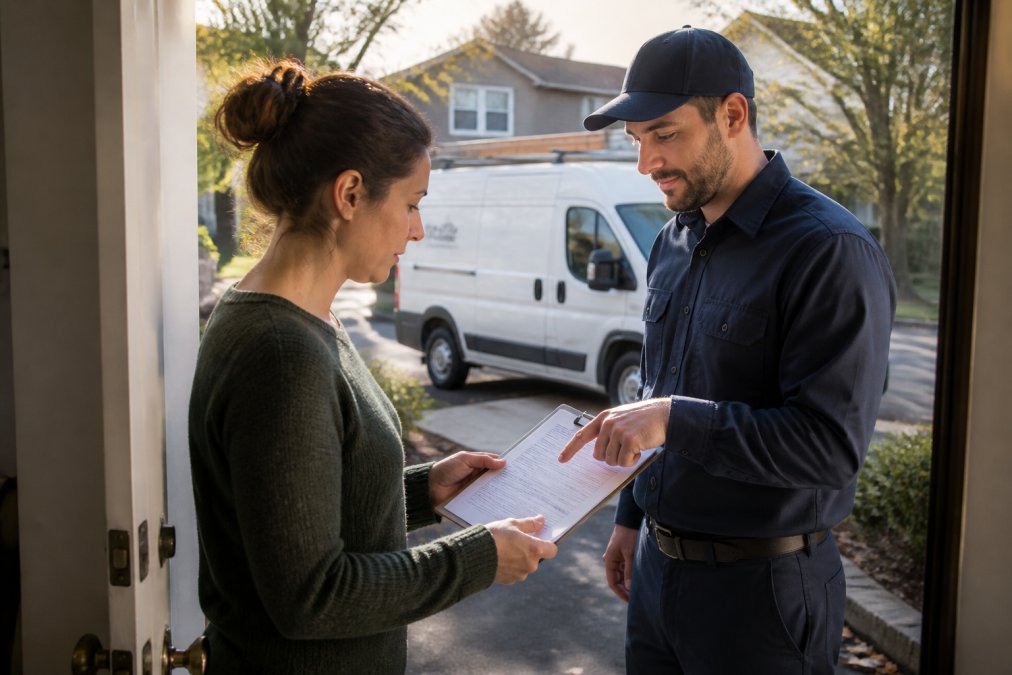
| Question | Good Answer | Warning Sign |
|---|---|---|
| What is your license number? | Provides it immediately | Deflects or says "the office handles that" |
| Will you pull a permit? | Yes, and it is included | "You do not need one for this" |
| Can I see your insurance certificate? | Sends it same day | Changes the subject |
| Who does the actual work? | Names the technician | Vague about subcontractors |
| What happens if the repair fails? | Explains warranty terms in writing | No written warranty offered |
Ask for a written recommendation before work begins. A company confident in its diagnosis will put the findings and the proposed repair in writing. That single document protects you if the scope of work changes mid-job.
Red Flags of Unlicensed Contractors and How to Report Them
Cash-only demands, pressure to decide today, no written estimate, and a vehicle with no company branding are the classic markers. So is a technician who cannot produce a license number when asked directly.
Other red flags worth naming:
- No physical business address, only a cell phone number
- Quotes a price far below every other estimate you received
- Asks you to pull the permit in your own name
- Cannot explain what the diagnostic found in plain language
- Offers to start work immediately without a written scope
If you suspect unlicensed activity, report it to your state licensing board and to your state's consumer protection office. The Federal Trade Commission consumer complaint process accepts reports on deceptive contractor practices, and state boards can investigate licensing violations directly. Reporting protects the next homeowner, and boards act on patterns.
This matters beyond one job. Unlicensed work often surfaces at resale, when an inspector finds an unpermitted installation and the seller has to pay to correct it.
Hiring the wrong technician is an expensive lesson, and it is entirely avoidable with ten minutes of verification. If you would rather skip the research and work with a team whose licensing, insurance, and certifications are already in order, Tornado HVAC serves Bergen, Essex, Morris, Passaic, and Union counties with 24/7 emergency service, professional diagnostics, and clear written recommendations before any work begins. Our membership plans cover seasonal maintenance and tune-ups to keep your system performing. Schedule service with Tornado HVAC and get a written recommendation before a single tool comes out of the van.
Frequently Asked Questions
Why is it important to verify HVAC technician credentials before hiring?
Verifying HVAC technician credentials protects your home, your money, and your safety. A technician with an active license and EPA 608 certification has met state and federal requirements for handling refrigerants and installing equipment to code. Unlicensed workers may cut corners, void manufacturer warranties, or leave unsafe gas and electrical connections. Checking credentials also confirms the business carries liability insurance and any required surety bond, so you are not left covering damage if something goes wrong during the job.
What is the difference between an HVAC license and an EPA 608 certification?
An HVAC license is issued by a state regulatory board and covers the legal right to perform contracting work, including permits and code compliance. EPA 608 certification is a federal credential required under the Clean Air Act for anyone who handles refrigerants. A technician can hold EPA 608 certification without a state contractor license, so you should confirm both. Look up the license number in the state's verification portal and ask for the certification number for refrigerant work.
How do I check if an HVAC company is properly insured?
Ask the company for a certificate of insurance showing general liability coverage and, where required, workers' compensation. Then call the insurance carrier listed on the certificate to confirm the policy is active and the coverage amounts match what the company claims. For bonding, request the surety company's name and verify the bond is current. A legitimate HVAC contractor will provide these documents without hesitation. If a company refuses or stalls, treat that as a warning sign.
What questions should I ask an HVAC technician before hiring?
Ask for the license number and the name of the state board that issued it, then verify both yourself. Request the EPA 608 certification number if the work involves refrigerants. Ask whether the company carries liability insurance and a surety bond, and for proof. Confirm who will actually perform the work, whether permits are included, and how the company handles written recommendations and warranties. Finally, ask for the business entity's full legal name so your lookup matches the right record.