 ultimate-guide
HVAC Maintenance for Energy Savings: 2026 Guide
Table of Contents
- How HVAC Maintenance Lowers Energy Bills
- HVAC Seasonal Tune-Up Checklist
- HVAC Filter Replacement Frequency and Airflow
- How to Improve Home Air Quality
- Smart Thermostats and System Diagnostics
- Federal Tax Credits for Energy-Efficient HVAC in 2026
- DIY vs. Professional Maintenance: When to Call a Pro
- Frequently Asked Questions
Last Updated: September 14, 2026
How HVAC Maintenance Lowers Energy Bills
HVAC maintenance for energy savings works because a system that is clean, correctly charged, and properly calibrated doesn't have to work as hard to hit the same thermostat setting. A furnace or air conditioner that "still runs" is often costing far more per month than the homeowner realizes. The U.S. Department of Energy's Energy Saver guidance on heating and cooling notes that heating and cooling account for the largest share of a typical home's energy use, which means small efficiency losses compound into real money over a season.
The Cost of Neglected Systems
A neglected system doesn't fail all at once. It degrades quietly. Refrigerant levels drift, coils collect dust, and the blower motor draws more current to move the same air. None of that shows up as a dramatic breakdown, but it shows up on your utility bill and in a shorter equipment lifespan. Qualified technicians describe this as "efficiency creep," and it's a common issue found during diagnostic visits.
Why Seasonal Tune-Ups Matter
A seasonal tune-up catches the small problems before they become expensive ones. Think of it as an oil change for your HVAC system: cheap insurance against a much larger repair. Two visits a year, one before cooling season and one before heating season, keep refrigerant charge, airflow, and electrical components within spec so the system runs at the efficiency it was rated for.
HVAC Seasonal Tune-Up Checklist
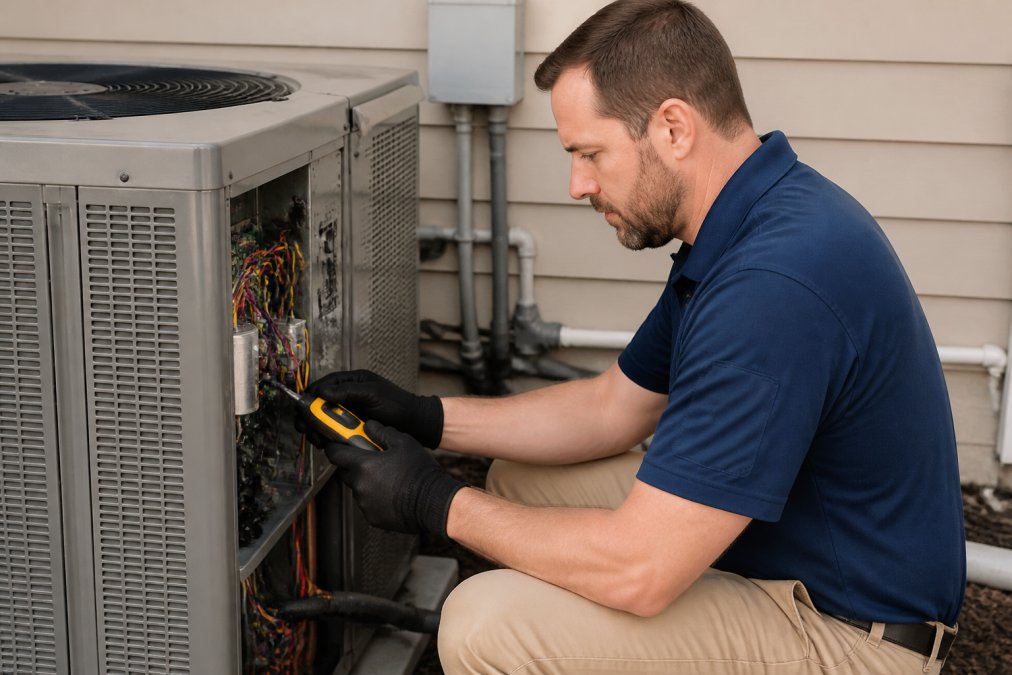
An HVAC seasonal tune-up checklist is the fastest way to make sure nothing gets skipped. Here's what a thorough visit covers, split by season.
Spring and Summer Tasks
- Wash or replace the air filter
- Clear the condensate drain line to prevent clogs and water damage
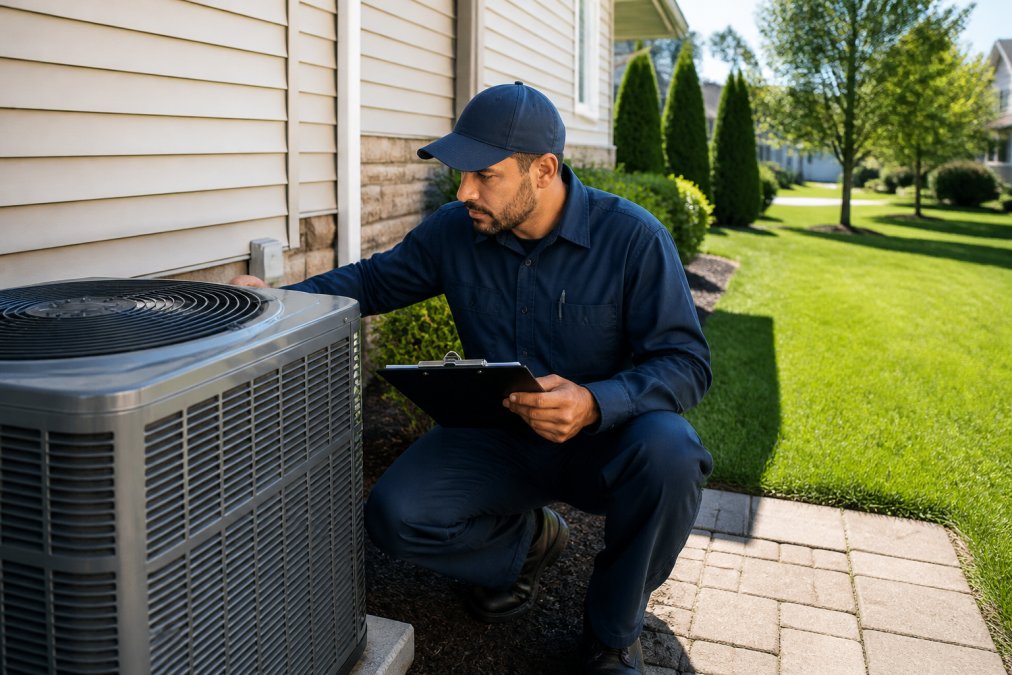
- Clean the outdoor condenser coil of grass, pollen, and debris
- Check refrigerant levels and look for leaks
- Test the capacitor and contactor on the condenser unit
- Verify thermostat calibration against a known reference
Fall and Winter Tasks
- Inspect the heat exchanger for cracks or corrosion
- Clean the blower motor and check its amp draw
- Test the ignitor, flame sensor, and safety switches
- Check gas pressure and combustion on furnaces and boilers
- Inspect the flue and venting for blockages
- Confirm the drain line and condensate pump are clear
HVAC Filter Replacement Frequency and Airflow
Replace a standard 1-inch filter every 30 to 90 days; replace thicker media filters every 6 to 12 months. The exact interval depends on filter thickness, household pets, and local dust levels. A clogged filter is the most common cause of restricted airflow, and restricted airflow forces the blower motor to work harder while the coil ices up or overheats.
Filter Types and MERV Ratings
MERV (Minimum Efficiency Reporting Value) is a rating that describes how effectively a filter captures particles of a given size. Higher MERV means finer filtration, but also more resistance to airflow.
| Filter Type | Typical MERV | Replacement Interval | Best For |
|---|---|---|---|
| Basic fiberglass | 1-4 | 30 days | Dust and lint only |
| Pleated polyester | 8-11 | 60-90 days | Most homes, pets |
| High-efficiency media | 13-16 | 6-12 months | Allergies, asthma |
| HEPA (standalone unit) | 17+ | Per manufacturer | Room-level purification |
How to Improve Home Air Quality
Air quality and energy efficiency are the same conversation more often than homeowners expect. Every particle a filter catches, every gap in accessible ductwork that gets sealed, and every point of humidity you pull out of the air changes how hard your HVAC system has to work to hold a setpoint. Treating air quality as a separate project from efficiency usually means paying twice for the same result.
The Efficiency Side of Air Quality
Three mechanisms connect indoor air quality to your utility bill:
- Filter loading. A filter that is doing its job is also getting dirtier, and a loaded filter raises static pressure across the blower. The blower compensates by drawing more current, which shows up as higher runtime and shorter motor life.
- Duct leakage. Gaps in accessible ductwork pull in unconditioned attic or crawlspace air, which carries dust, humidity, and in some cases combustion byproducts from nearby equipment. Sealing those gaps reduces both the contaminant load and the amount of conditioned air you are paying to lose.
- Humidity control. Latent load (the energy used to remove moisture) can be a meaningful share of summer runtime. Holding indoor humidity between 30% and 50% keeps the coil from running longer cycles to hit the same temperature.
Practical Steps That Also Cut Energy Use
- Seal visible gaps in accessible ductwork with mastic or foil tape rated for HVAC use; this reduces dust pull-in and air loss at the same time
- Keep indoor humidity between 30% and 50% with a properly sized dehumidifier or a system that manages latent load
- Run kitchen and bath exhaust fans to remove moisture and cooking byproducts at the source rather than filtering them out of the air later
- Upgrade to a whole-home media filter cabinet if you are replacing a 1-inch filter monthly; the larger surface area holds more dust before pressure rises, which is better for both air quality and blower amp draw
- Add UV purification or a polarized-media filter only after airflow has been verified, since adding resistance to a system that is already at its static pressure limit makes efficiency worse, not better
- Schedule a ductwork inspection if you notice uneven room temperatures, which often signals leakage that is also wasting conditioned air
The EPA's indoor air quality resources outline why ventilation and humidity control matter as much as filtration for a healthy home, and the same principles apply to how efficiently the system moves air.
Smart Thermostats and System Diagnostics
A smart thermostat is only as good as the data it acts on. The efficiency gain does not come from the device itself; it comes from removing unnecessary runtime and from catching performance drift before it becomes a repair. That is where the current generation of controls separates itself from a basic programmable unit.
Beyond Scheduling: What Modern Controls Actually Do
- Geofencing. The thermostat uses your phone's location to switch between home and away setpoints automatically, so you are not paying to condition an empty house because you forgot to adjust the schedule.
- Occupancy sensing. Room-level sensors detect whether anyone is actually in a space and bias airflow or setpoint toward occupied zones, which matters most in homes with unused rooms or upstairs/downstairs splits.
- Runtime analytics. Most current units log heating and cooling runtime by day and outdoor temperature. A system that runs longer this August than last August at the same outdoor temperature is telling you something changed, and that signal is worth acting on before peak season.
- Demand-response participation. Some utilities enroll compatible thermostats in peak-shaving programs that briefly adjust setpoints during grid stress events in exchange for bill credits. Check with your utility before assuming your thermostat qualifies.
How to Estimate Your Own Savings
Generic claims of 5% to 20% savings are not useful for a specific home. A more honest approach is to build a rough estimate from your own numbers:
- Pull twelve months of utility bills and separate heating and cooling costs from the rest.
- Estimate the share of that cost attributable to runtime that a setback or automation change would eliminate. A common starting assumption is that each 1°F of setback for eight hours a day reduces heating or cooling energy by roughly 1%, though the real figure depends on your envelope, equipment, and climate.
- Multiply that share by your annual heating and cooling spend to get a rough annual savings figure.
- Compare that figure to the installed cost of the thermostat or control upgrade to get a simple payback period.
This is a planning estimate, not a guarantee. The point is to replace a marketing percentage with a number tied to your own bills.
What Professional Diagnostics Measure
Diagnostics are how you confirm that the system is running at the efficiency the thermostat assumes it is. A thorough visit measures:
- Static pressure across the blower to confirm airflow is within the equipment's rated range
- Temperature split between return and supply air, compared against the manufacturer's target for the current outdoor conditions
- Refrigerant superheat and subcooling on the cooling side to confirm charge is correct, not just present
- Combustion analysis and flue temperature on the heating side to confirm the furnace or boiler is burning at its rated efficiency
If your smart thermostat shows longer runtimes than last year at the same outdoor temperature, that is the signal to schedule diagnostics. The control tells you something changed; the instruments tell you what.
Federal Tax Credits for Energy-Efficient HVAC in 2026
Federal tax credits for energy-efficient HVAC reward homeowners who upgrade to qualifying high-efficiency equipment. The IRS guidance on the Energy Efficient Home Improvement Credit and the ENERGY STAR federal tax credit overview explain which equipment qualifies and how to claim it. Credit amounts and eligibility rules change, so confirm current figures on those official pages before you buy; a qualifying installation usually requires a manufacturer certification statement from your contractor.
Replacing an aging system is often the single biggest efficiency lever available. Pairing a qualifying heat pump or high-efficiency furnace with a properly sealed duct system and a calibrated thermostat gets you the rated performance, not just the rated label.
DIY vs. Professional Maintenance: When to Call a Pro
DIY maintenance covers the low-risk, high-frequency tasks: filter changes, keeping the outdoor unit clear, and visual checks. Professional maintenance covers everything that requires instruments, refrigerant handling, or gas work. Here's the split most homeowners should follow.
| Task | DIY or Pro | Frequency | Why It Matters |
|---|---|---|---|
| Filter replacement | DIY | 30-90 days | Protects airflow and blower motor |
| Outdoor unit clearing | DIY | Monthly in season | Prevents condenser overheating |
| Thermostat calibration | DIY or Pro | Seasonally | Keeps setbacks accurate |
| Refrigerant charge check | Pro | Annually | Low charge raises energy use |
| Coil cleaning (evaporator) | Pro | Annually | Restores heat transfer |
| Drain line flush | DIY or Pro | Seasonally | Prevents water damage and shutdowns |
| Combustion and heat exchanger | Pro | Annually | Safety and efficiency |
Call a professional immediately if you smell gas, hear banging or screeching from the furnace, see ice on the refrigerant lines, or notice the breaker tripping repeatedly. Those aren't maintenance items; they're repair calls.
Your system's efficiency is decided long before the first cold snap or heat wave, in the maintenance you did or didn't do during the shoulder seasons. Tornado HVAC provides seasonal maintenance and tune-ups, professional diagnostics, and clear written recommendations for homeowners across Bergen, Essex, Morris, Passaic, and Union counties, along with 24/7 emergency service when something fails. If you want your heating and cooling running at peak performance, schedule service with Tornado HVAC and get a clear picture of what your system actually needs.
Frequently Asked Questions
What is the $5000 rule for HVAC systems?
The $5,000 rule is a rough guideline: multiply the age of your system by the repair cost. If the result exceeds $5,000, replacement is often the better financial move. For example, a 12-year-old system needing a $500 repair gives $6,000, suggesting replacement. This is not a hard rule; a professional evaluation and written recommendation should guide the final decision.
Is HVAC maintenance really necessary if my system seems fine?
Yes. Most HVAC failures start as small issues, like low refrigerant or a dirty coil, that show no obvious symptoms until efficiency drops or the system breaks down. Regular HVAC maintenance catches these early, keeps energy consumption in check, and extends system longevity. A seasonal tune-up is far less disruptive than an emergency repair in the middle of summer or winter.
Is there a federal tax credit for energy-efficient HVAC in 2026?
Yes. The Energy Efficient Home Improvement Credit offers up to $2,000 per year for qualifying heat pumps and $600 for qualifying furnaces, boilers, or central air conditioners. You can also claim up to $1,200 for insulation and air sealing. Credits apply to qualifying high-efficiency equipment installed in your primary residence. Keep your receipts and manufacturer certification statements for tax filing.
What specific maintenance tasks improve HVAC energy efficiency?
Key tasks include replacing air filters regularly, cleaning evaporator and condenser coils, checking refrigerant levels, calibrating the thermostat, sealing duct leaks, and clearing drain lines. These steps reduce energy consumption, improve airflow, and help your HVAC system run closer to its rated efficiency. A professional tune-up covers all of these and includes system diagnostics you cannot easily do yourself.