 ultimate-guide
HVAC System Efficiency Tips 2026: Cut Energy Bills
Table of Contents
- Why HVAC System Efficiency Matters More in 2026
- SEER2, HSPF2, and the New Refrigerant Rules Explained
- HVAC Tax Credits 2026: What Homeowners Can Actually Claim
- Your HVAC Seasonal Maintenance Checklist for Peak Efficiency
- Smart Thermostat Energy Savings: Real Numbers and Setup Tips
- Retrofitting vs. Replacing: Which Makes Financial Sense
- Ductwork, Insulation, and Airflow: The Hidden Efficiency Leaks
- Frequently Asked Questions
Last Updated: September 21, 2026
Why HVAC System Efficiency Matters More in 2026
HVAC system efficiency stopped being a background concern and became a line item on every homeowner's budget. Federal efficiency standards tightened again this year, refrigerant rules changed, and utility rates in the Northeast keep climbing.
At Tornado HVAC, we field the same question constantly: is my system actually running as well as it should?
Here's the short answer. Most homes lose efficiency through a handful of fixable problems, not a failing furnace. A clogged filter, a thermostat running on a decade-old schedule, or leaky ductwork can quietly add hundreds to your annual energy consumption. This guide covers the specific efficiency moves that matter in 2026, from the new SEER2 baseline to the tax credits worth claiming.
The stakes are higher now. Equipment must meet a higher minimum efficiency rating than it did just a few years ago, which means older systems fall further behind with every season.
SEER2, HSPF2, and the New Refrigerant Rules Explained
SEER2 is the updated Seasonal Energy Efficiency Ratio that measures cooling performance under real-world duct conditions. HSPF2 does the same job for heating.
The Department of Energy raised minimum efficiency standards in 2023, and the 2026 landscape reflects that shift.
What A2L Refrigerants Mean for Your Existing System
Nothing changes immediately. An R-410A system can keep running and can still be repaired.
HVAC Tax Credits 2026: What Homeowners Can Actually Claim
The federal tax credit structure rewards efficiency upgrades, and the tiers are worth understanding before you buy.
Your HVAC Seasonal Maintenance Checklist for Peak Efficiency
A seasonal maintenance checklist is the cheapest efficiency tool you own. Most of it takes under an hour.
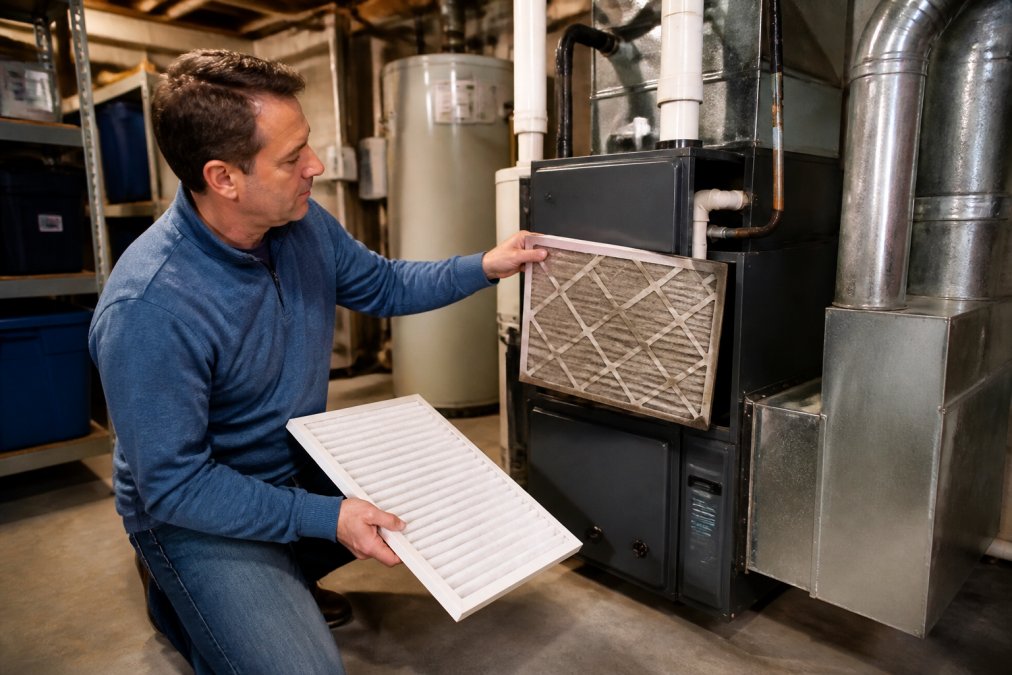
- Replace or clean the air filter (monthly during heavy use)
- Clear debris and vegetation from the outdoor condenser unit
- Check the condensate drain line for clogs
- Verify the thermostat schedule matches your actual routine
- Inspect visible ductwork for disconnected joints or torn insulation
- Listen for new noises at startup
- Check that supply vents aren't blocked by furniture or rugs
DIY Tasks vs. What Needs a Technician
Filter changes, vent clearing, and outdoor unit cleanup are safe homeowner tasks. Anything involving refrigerant, electrical components, gas connections, or the blower motor belongs to a licensed technician.
Smart Thermostat Energy Savings: Real Numbers and Setup Tips
Smart thermostat energy savings come from scheduling and setback, not from the device itself. A thermostat that learns your routine and stops conditioning an empty house will outperform a programmable unit that nobody programs. The gap most guides miss is that "smart" settings need to be tuned to your equipment type, a heat pump and a gas furnace want different setback strategies.
Specific Settings That Drive Savings in 2026
These are the configuration choices that matter, with starting points most practitioners find effective:
- Cooling setback depth: 7°F to 10°F above your occupied setpoint during unoccupied hours. Wider than 10°F in humid climates can let indoor humidity climb, which forces the system to work harder on recovery.
- Heating setback depth: 5°F to 8°F below occupied setpoint for gas furnaces and boilers. For heat pumps, cap the setback at 3°F to 5°F unless the thermostat has a dedicated heat-pump recovery mode.
- Heat pump balance point: Set the lockout temperature so auxiliary resistance heat only engages below the outdoor temperature where the heat pump can no longer keep up. This single setting prevents the most common heat pump efficiency mistake.
- Recovery ramp: Enable gradual recovery (sometimes labeled "smart recovery" or "adaptive recovery") so the system starts 30 to 60 minutes before your wake time instead of blasting to temperature at 6 a.m.
- Geofencing radius: Set the away trigger to roughly a half-mile from home. Tighter radii cause false away events; wider radii waste conditioning time.
- Fan circulation: Run the blower 15 to 20 minutes per hour on low speed to even out room temperatures without running the compressor. This helps most in two-story homes with temperature stratification.
Features to Use Carefully
Manual override defeats the schedule. A household that overrides daily sees little benefit from any learning algorithm. Aggressive setbacks on a heat pump can trigger expensive auxiliary resistance heat during morning recovery, which erases the savings from the setback itself. And "eco mode" on some platforms prioritizes comfort over efficiency during peak utility hours, check which behavior your utility's demand-response program actually rewards before enrolling.
What to Check Before You Buy
Not every smart thermostat works with every system. Variable-speed equipment, dual-fuel setups, and communicating systems often require the manufacturer's own thermostat to access full efficiency modes. Before buying, confirm compatibility with your specific model, and confirm whether the device supports the ENERGY STAR smart thermostat specification, that certification requires verified savings claims rather than marketing estimates.
Retrofitting vs. Replacing: Which Makes Financial Sense
Most guides frame this as an age question. It isn't. The right call depends on three measurements: equipment condition, envelope performance, and how the system was sized in the first place. Get those three data points and the retrofit-versus-replace decision usually makes itself.
The Diagnostic Sequence
Before pricing equipment, run this sequence:
- Load calculation. A room-by-room Manual J calculation tells you what the home actually needs. If the existing system is oversized, replacing it with the same tonnage repeats the mistake.
- Static pressure and airflow test. High static pressure means the duct system is choking the equipment. A new unit on the same ducts will underperform the same way.
- Refrigerant charge and superheat/subcool check. A system that's low on charge or overcharged runs inefficiently regardless of age.
- Combustion analysis on gas equipment. Cracked heat exchangers and combustion issues are replacement triggers, not retrofit candidates.
- Envelope assessment. Air sealing and insulation reduce the load. If the load drops enough, a smaller replacement unit may be the right answer, and a smaller unit costs less to run.
The ROI Framework
Retrofitting wins when the equipment has remaining service life and the losses are in the envelope or the ducts. The highest-return retrofit work, in rough order:
- Air sealing around penetrations, rim joists, and attic hatches
- Attic insulation to current recommended R-values for the climate zone
- Duct sealing at accessible joints and disconnected runs
- Thermostat upgrade with proper setback configuration
- Window and door weatherstripping
The Decision Table
| Situation | Better Move | Why |
|---|---|---|
| System under 10 years, minor issue | Repair + retrofit | Equipment life remains |
| R-410A system needing major recharge | Replace | Refrigerant cost climbing |
| Failing compressor or heat exchanger | Replace | Repair exceeds value |
| Comfort issues, equipment healthy | Retrofit | Airflow and envelope problem |
| Utility bills rising, no equipment fault | Retrofit first | Ducts and controls likely |
| Oversized system short-cycling | Replace with correct size | Load calc required first |
| Ducts in unconditioned space, leaky | Retrofit (seal + insulate) | Highest return per dollar |
How to Know the Retrofit Worked
Track two things after retrofit: runtime hours per day at a given outdoor temperature, and the gap between setpoint and actual room temperature across rooms. If runtime drops and room-to-room variance narrows, the retrofit is doing its job. If runtime is unchanged after sealing and insulation, the problem was never the envelope, it was the equipment or the ducts, and replacement moves up the list.
Ductwork, Insulation, and Airflow: The Hidden Efficiency Leaks
Ductwork is where efficiency quietly disappears. Leaky joints and disconnected runs push conditioned air into attics and crawlspaces instead of living space. The system runs longer to compensate, and you pay for air you never feel.
Frequently Asked Questions
How can I make my HVAC system more energy efficient?
Start with the basics: replace air filters every one to three months, seal gaps in ductwork, and set your thermostat to a consistent temperature. Schedule an annual tune-up so a technician can check refrigerant levels, clean coils, and test the compressor. If your system is older than 10 to 15 years, ask about a load calculation to see whether a right-sized replacement would lower your energy consumption more than repairs.
What are the latest SEER2 efficiency standards for 2026?
SEER2 and HSPF2 ratings replaced the older SEER and HSPF metrics, using a more realistic testing method that accounts for real ductwork static pressure. In northern states, split-system air conditioners must meet a minimum of 13.4 SEER2, while heat pumps need at least 14.3 SEER2 and 7.5 HSPF2. Higher ratings mean better baseline efficiency, but proper installation and ductwork matter just as much as the number on the label.
Do HVAC tax credits 2026 still apply to heat pumps and furnaces?
Federal incentives have shifted over the past few years, so the exact credit amount depends on the equipment type and efficiency tier. High-efficiency air-source heat pumps and furnaces generally qualify for the largest credits, with lower tiers for standard upgrades. Because incentive tiers change annually, check the current IRS guidance or ask your installer for documentation before you buy, so you can claim what you are owed.
Is a smart thermostat worth it for energy savings?
Smart thermostats help most when your schedule is unpredictable. Features like geofencing, learning schedules, and peak-hour adjustments can trim runtime during the hours when electricity costs the most. Homes that already keep a steady schedule may see smaller gains. Pairing a smart thermostat with a maintenance plan and correct system sizing gives you the best shot at measurable savings on your utility bill.